Do these new zoning rules really allow bars, cannabis and vape shops?

Toronto’s new neighbourhood retail rules were promoted as a way to bring small shops and services closer to residents. But there is a less obvious consequence: once retail and restaurant uses are permitted in residential areas, the City has limited control over what kind of businesses can open.

In a December 16, 2024 Toronto Star article about the proposed changes, City Manager Michael Noble acknowledged that allowing retail stores and restaurants into residential neighbourhoods could lead to cannabis stores and businesses applying for liquor licences.

“There is nothing we’re doing to encourage alcohol or cannabis sites,” Noble said. “But we don’t have the ability to (prevent it). Any retail store, anywhere in the city, theoretically can be used for a cannabis site, or someone could apply for a liquor licence. And that applies here.”

Bars

It is important to understand that the City does not issue liquor licences.

Once a restaurant, café or other eligible food-service business is permitted under Toronto’s zoning, the owner can apply to the Alcohol and Gaming Commission of Ontario (AGCO) for a liquor licence to serve alcohol on site.

Residents can object to the application, but the decision to grant the liquor licence is made through the provincial licensing system, and NOT by the City of Toronto.

In practical terms, the province has almost never declined to grant a liquor licence over the objection of neighbours.

Once the zoning for such activity has been approved by the municipality, it’s difficult to argue that a liquor license may not be suitable on the basis that it’s a residential area.

In fact, the City of Toronto made the decision last year to change the Residential Zoning by-law specifically to allow such activity on designated residential streets. By doing so, they have opened the door to allow liquor-serving establishments to operate on those streets even if those streets have been residential for decades.

This would include bars as well as restaurants and cafes.

The by-law changes also do not provide any new protections or restrictions on those types of businesses. There are no mandatory operating hours, for example. And there are no restrictions on alcohol service close to a school or any other sensitive location (like a mosque or a church).

Cannabis

Like alcohol, cannabis retail stores are licensed by the Province through the Alcohol and Gaming Commission of Ontario (AGCO). They are NOT licensed by the City of Toronto.

When cannabis was legalized, municipalities were given the opportunity to opt out of cannabis retail. Toronto chose not to opt out.

Provincial law places an important limit on municipal zoning authority. The Cannabis Licence Act says that a municipal by-law cannot distinguish between a retail use that sells cannabis and one that does not. In plain English, if retail is allowed at a location Toronto cannot use zoning to prohibit cannabis sales.

The only restriction is that a cannabis store cannot be located within 150 metres of a school. There is no provincial minimum distance between cannabis stores.

Cigarettes, alcohol and vape products

Tobacco and vape products can be sold from retail stores permitted under the new zoning changes, subject to the provincial laws and regulations governing the sale of these products.

Again, the zoning rules permit retail stores and do not dictate what kind of businesses may choose to open.

Although City officials and Mayor Chow promoted a vision of the friendly local corner store or café, businesses who take advantage of the new zoning rules could also be corporate franchises or liquor stores or vape shops. Ontario already permits convenience stores to sell alcohol.

City Council also acknowledged that bars and cannabis stores are permitted

The possibility of cannabis stores and liquor sales was clearly on Council’s radar when the zoning changes were approved last year.

Council directed the City to work with the Province to consider changing its laws so that Toronto could have more control over where cannabis stores and liquor sales could operate in residential neighbourhoods.

But asking the province to make those changes is not the same as having those protections in place before changing the by-law.

Council opted to proceed with the new zoning rules rather than waiting to see whether the province could provide those additional powers and protections for residents.

Below are the motions that Council voted to include:
  • 8. City Council request the Ministry of the Attorney General to initiate the process for amendments to the Cannabis License Act, 2018 and/or any applicable regulations or ministry directives for the purpose of restricting the location of cannabis retail stores within lands designated as Neighbourhoods in the City’s Official Plan, including options to limit the total number of cannabis retail stores per ward, and direct the City Manager, the City Solicitor and the Chief Planner and Executive Director, City Planning, to work with the Ministry to support this request, and report back through the monitoring program.
  • 9. City Council request the Ministry of the Attorney General to initiate the process for amendments to the Liquor Licence and Control Act, 2019 (LLCA), and/or any applicable regulations or ministry directives for the purpose of restricting the granting of Liquor Sales Licenses and Convenience and Grocery Store licenses within lands designated as Neighbourhoods, in the City’s Official Plan and direct the City Manager, the City Solicitor and the Chief Planner and Executive Director, City Planning, to work with the Ministry to support this request, and report back through the monitoring program.

Contact Your Councillor and Mayor – Suggested Email

If you are concerned about the zoning changes affecting residential properties, you may wish to contact your City Councillor and the Mayor to express your views and ask whether they would support restoring residential zoning and removing the new commercial permissions.

Below is a suggested email you can use. Feel free to customize it and add your own concerns or comments.

List of Councillors and emails click [HERE]

Suggested email


Dear Councillor and Mayor,

I live at [insert your address] and recently learned that my property is now subject to new zoning rules that allow a wide range of businesses to operate from residential properties.

I was surprised to learn that these changes had been made and that businesses can now operate from residential properties without the need for approval through the Committee of Adjustment process.

I am concerned about what this change means for my home and my neighbourhood. This is a residential area, and I believe residents should have been consulted and given an opportunity to participate in decisions that affect their neighbourhood. I am also concerned that the new rules place greater emphasis on enabling new business activity than on protecting the interests and expectations of residents living in these areas.

I would like to ask whether you would support restoring the residential zoning and removing these new commercial permissions from residential properties.

I would also appreciate knowing why this change was made, what consideration was given to the interests of residents, and whether you would support reviewing it.

Thank you for taking the time to respond.

Sincerely,

[Name]
[Address or neighbourhood]

What the City said – and what the evidence shows

City Planning presented several reasons for expanding commercial permissions in residential neighbourhoods. COTRA reviewed the City’s reports, data, maps and supporting information. 

CLAIM 01 – WHAT THE CITY SAID

Small-scale retail in Neighbourhoods is mandated by the Official Plan.

WHAT THE EVIDENCE SHOWS

The Official Plan does not require blanket rezoning of residential properties. It says new small-scale retail, service and office uses “may be permitted” in Neighbourhoods where they have minimal adverse impacts on nearby residents, including impacts from noise, parking, deliveries and loading.

COTRA questions whether broad permissions for bars, restaurants, patios and other potentially higher-impact uses on residential streets meet that standard.

The concern is not theoretical. City Council itself subsequently asked the Province to consider restrictions on cannabis retail stores and liquor licences in areas designated as Neighbourhoods, and directed staff to examine safety considerations related to cannabis and alcohol.

CLAIM 02 – WHAT THE CITY SAID

The Committee of Adjustment process is a barrier to small businesses.

WHAT THE EVIDENCE SHOWS

The Committee of Adjustment process provides notice and an opportunity for residents to comment on an individual proposal and its potential local impacts.

City data cited in the City’s materials showed that approximately 90% of applications for non-residential uses in Neighbourhoods were approved.

This suggests that the existing process was not simply preventing small businesses from opening. It provided a way to consider individual properties while allowing residents to raise concerns about issues such as parking, traffic, noise and compatibility.

COTRA believes a targeted approval process is preferable to blanket permissions across residential areas.

Source: City of Toronto. Neighbourhood Retail & Services. Information and Reports May 2024 Proposals Report Materials: Attachment 4: Research and Consultation.

CLAIM 03 – WHAT THE CITY SAID

The changes will improve walkability by providing more local shops and services.

WHAT THE EVIDENCE SHOWS

Some neighbourhoods would benefit from better access to local shops and services. COTRA agrees that local retail can play an important role in complete communities.

But a blanket approach assumes that the same need exists everywhere.

Many neighbourhoods are already well served by established commercial streets, plazas and other nearby retail. Allowing new businesses on residential streets where demand has not been demonstrated could also create unfair competition for existing small businesses operating on established commercial streets, where they face commercial rents and other costs.

COTRA supports a targeted approach: identify where services are actually needed, then determine appropriate locations in consultation with local residents and businesses.

CLAIM 04 – WHAT THE CITY SAID

City maps show gaps in access to retail and services.

WHAT THE EVIDENCE SHOWS

COTRA found significant problems with the City’s retail and services mapping.

The City’s map does not capture all existing retail activity, including:

  • existing legal non-conforming businesses;
  • commercial areas governed by former City of Toronto zoning by-laws;
  • Employment Areas such as Geary Avenue; and
  • some existing plazas in Commercial Local (CL) zones that are misclassified as residential.

These omissions can make areas appear to have fewer retail and service options than they actually do.

The City’s own earlier report explains that existing retail and service uses in Neighbourhoods may be legal non-conforming, may have been established through a rezoning or minor variance, or may have existed under earlier zoning rules.

If the underlying map does not show the full extent of existing commercial activity, it is difficult to use that map as evidence that blanket rezoning is necessary.

Source: City of Toronto. Neighbourhood Retail & Services. Information and Reports December 2024 Final Report Materials and Draft Zoning By-law Amendments:  Proposals Report Materials: PH17.2 – Expanding Housing Options in Neighbourhoods – Neighbourhood Retail and Services Study Phase Two Final Report

CLAIM 05 – WHAT THE CITY SAID

The changes will bring vacant or “ghost” storefronts back into productive use.

WHAT THE EVIDENCE SHOWS

Some properties identified as former commercial or “ghost” stores have since been converted to residential use, including multi-unit rental housing.

Allowing commercial use again can create an incentive to convert existing rental housing to commercial space.

Under Section 50(1)(b) of Ontario’s Residential Tenancies Act, a landlord may terminate a tenancy to convert to non-residential use, subject to the requirements of the Act.

This creates a potential pathway for the loss of existing rental housing in order to create commercial space.

COTRA questions whether converting housing into small commercial spaces is an appropriate response when the need for additional retail has not been demonstrated in the specific neighbourhood.

Sources:
City of Toronto. Neighbourhood Retail & Services. Information and Reports December 2024 Final Report Materials and Draft Zoning By-law Amendments:  Proposals Report Materials: PH17.2 – Expanding Housing Options in Neighbourhoods – Neighbourhood Retail and Services Study Phase Two Final Report

Ontario Residential Tenancies Act, Section 50:  https://www.ontario.ca/laws/statute/06r17#BK72

CLAIM 06 – WHAT THE CITY SAID

The changes will help replace lost plazas and grocery stores.

WHAT THE EVIDENCE SHOWS

The City’s own zoning framework places significant limits on the size of new commercial establishments.

On Major Streets, the maximum is generally:

  • 130 m2 (interior neighbourhoods) 150 m²  (Major Streets) for an individual establishment;
  • 400 m² total in an apartment building, subject to additional requirements.

A 150 m² space is approximately 1,600 square feet. That may accommodate a small local store or service, but it is not comparable to a typical full-service grocery store or shopping plaza.

COTRA therefore questions whether converting individual residential properties into small commercial spaces can realistically replace the larger grocery stores that have been lost.

There is also a broader planning question: if larger commercial areas are needed, shouldn’t the City be supporting existing plazas and commercial streets rather than dispersing small businesses onto residential streets?

City of Toronto. Neighbourhood Retail & Services. Information and Reports December 2024 Final Report Materials and Draft Zoning By-law Amendments:  Proposals Report Materials: PH17.2 – Expanding Housing Options in Neighbourhoods – Neighbourhood Retail and Services Study Phase Two Final Report

CLAIM 07 – WHAT THE CITY SAID

The new permissions are a reasonable way to support small businesses and reduce red tape.

WHAT THE EVIDENCE SHOWS

Reducing red tape can benefit small businesses. But eliminating the individual review process also eliminates an important safeguard for neighbouring residents.

The previous process allowed the City to consider the circumstances of a particular property and allowed nearby residents to comment on issues such as noise, parking, traffic, deliveries and compatibility. It’s worth noting that the Ford government removed the right of appeal for neighbours under the CoA process, significantly streamlining development. It’s hard to understand why City Planning would want to remove the CoA process entirely before giving this major new change a chance to play out.

COTRA’s position is not that small businesses should be prevented from opening. It is that where businesses are needed, the City should identify appropriate locations rather than automatically permitting commercial uses across large areas of residential zoning.

City Council’s own decision recognized the need to monitor the new system and report back after the earlier of two years or 100 building permits/business licences, including consideration of dedicated enforcement resources.

Which Major Streets are affected?

The new zoning rules apply to residentially zoned properties located on Major Streets.

What are “Major Streets” and why do they matter?

Major Streets are the streets shown on Official Plan Map 3 (Right-of-Way Widths Associated with Existing Major Streets).

They are generally the wider corridors (20 m and up) that the City uses for traffic and transit planning.

Some “Major Streets” are already commercial streets, while others are fully or mostly residential.

In June 2024, City Council approved apartment buildings of up to 6 storeys (and up to 60 units) and townhouses up to 4 storeys on all Major Streets. In November 2025, Council further approved commercial uses on these same streets.

The new rules were applied to Major Streets as shown in Map 3 rather than a street-by-street review to determine which residential streets were appropriate for increased density and commercial use. There is also no requirement to replace any housing that is converted to commercial use.

Which Major Streets?

The new zoning rules apply to residentially zoned properties located on Major Streets.

1. Start with the City’s Major Street maps

City Planning has published maps by ward showing the Major Streets in each area. These maps are the starting point for identifying which streets and properties may be affected.

View the City’s Major Street maps → [HERE]

2. Check for street segments excluded by Council

The City’s maps show all Major Streets, but Council voted to exclude certain street segments from the new zoning rules. These exclusions were requested by councillors for specific wards.

View the excluded Major Street segments → [HERE]

3. COTRA compiled a street-by-street list

Because the City did not provide a single consolidated list of the residentially zoned sections of Major Streets that remain subject to the new rules, COTRA attempted to bring this information together in one searchable list.

The list takes into account the Major Streets identified by City Planning and the street segments excluded by Council.

View the affected Major Street list →  [Searchable Major Street list]

Please note: This list is provided as a guide and may contain errors or omissions. If you are checking a specific property, we recommend also consulting the City’s maps and the applicable zoning by-law.

Major Streets – what council excluded (and what it rejected)

Because certain councillors requested it for their specific wards, Council approved the exclusion of specific Major Street segments from the new commercial permissions. These exclusions were actually written into the by-law (By-law 1509-2025).

Click here for the full list of streets that Council approved for exclusion HERE

Not all councillors had their requests to exclude certain streets allowed by council. For example, Councillor Stephen Holyday and Councillor Neethan Shan tried to exclude streets in their wards but council voted down his motion.

Major Streets Proposed for Exclusion but Not Approved by Council

Councillor Holyday’s Proposed Exclusions (Motion Defeated 16–1)

Street NameSegment
The West MallDundas Street West to Bloor Street
The West MallRathburn Road to Wellesworth Drive
The East MallBloor Street to Rathburn Road
Martin Grove RoadMimico Creek to Eglinton Avenue
Kipling AvenueBloor Street West to Eglinton Avenue (west side, south of Mimico Creek)
Islington AvenueDundas Street West to Eglinton Avenue
Royal York RoadDundas Street West to The Westway / Lawrence Avenue
Scarlett RoadEglinton Avenue to Dixon Road

(Note: Holyday’s motion excludes essentially all major streets in his Ward, Ward 2.)

Councillor Shan’s Proposed Exclusions (Motion Defeated 17–9)

Street NameLocation
Meadowvale AvenueWithin Ward 25 (Scarborough-Rouge Park)
Port Union Road
Military Trail

Links to Additional Information

Why are residents concerned?

What the City said – and what the evidence shows

Why are residents concerned?

For the first time, the City’s zoning rules now allow businesses to operate inside residential homes without any public consultation, rezoning, or Committee of Adjustment process that previously applied.

These concerns were among the primary reasons why 90% of surveyed residents opposed these changes, which now apply to properties on Major Streets across Toronto and, in Toronto and East York, to properties inside residential neighbourhoods.

RiskThe Reality of the Proposal
❌ BARS, CANNABIS & LIQUOR SALESThe plan permits licensed bars and cannabis/vape shops. The City cannot restrict these high-impact uses because they are governed by provincial licensing. (Cannabis only has a 150m setback from schools.)
❌ LOSS OF HOUSINGBy permitting non-residential (commercial) uses in residential buildings, landlords can legally evict tenants under the Residential Tenancy Act (Section 50(1)(b)) to convert units into businesses.

This creates a new pathway for tenant displacement and puts renters at risk.
❌ LATE-NIGHT NOISE & PATIOSThe City cannot restrict hours of operation, meaning late-night activity. Patios serving food/alcohol are allowed as a right and can operate until 2 AM under provincial licensing.
❌ NO NEIGHBOURHOOD SAYBusinesses open with no approval from the Committee of Adjustment (CoA), eliminating public notice and input from the neighbours who live nearby.
❌ ENFORCEMENT FAILURESNo new funding for bylaw officers. City will “monitor” for 2 years before seeking extra enforcement funding. Current system already under-resourced — complaints take months Any new funding would only fix existing backlog, not new problems. There’s no rollback mechanism Noise bylaws exclude loud voices; police don’t respond to noise complaints.  
❌ NO PARKING MANDATENo requirement to add spaces for parking or deliveries, pushing commercial traffic and congestion directly onto residential streets.
❌ PERMANENT CHANGEAny commercial use, once established, is a permanent, irrevocable change to your street’s zoning due to provincial legal non-conforming rights. This means that even if the by-law is changed back in the future, an existing business cannot be closed down.

What COTRA recommended to City Council

The Neighbourhood Retail & Services (NRS) proposal was the largest overhaul of residential zoning Toronto has seen in seventy years.

In advance of the November 12–14, 2025 Council vote, COTRA submitted recommendations based on what residents told us through our city-wide survey—more than 3,400 responses and 3,700 written comments.

1. Remove Neighbourhood Interiors from the proposal and from future consideration.

  • Residents were clear: retail and commercial don’t belong on quiet residential streets.
  • 90% of survey respondents opposed changing zoning rules to allow businesses to operate in Neighbourhood Interiors without consultation or approval.
  • 80% wanted the city to stop proposing bylaw changes that would permit businesses to operate in residential neighbourhoods.

2. Adopt a targeted approach for rezoning some Major Streets based on demonstrated need and developed in consultation with residents, Residents’ Associations, and local ward councillors.

  • 57% of survey respondents supported this measured approach.

Suggested criteria:

  • Limit retail conversion to stretches of Major Streets more than 500m from an existing Main Street or plaza – this is the same distance Planning prescribes in its report (p. 19).
  • Streets having sidewalks and safe pedestrian access.
  • Streets serviced by transit.
  • Permit retail on the ground floors of apartment buildings citywide.

3. Prioritize the development and support of existing commercial areas.

City investment and small-business support should concentrate on established retail corridors, not on converting existing housing in other areas.

  • 80% of respondents supported this rationale.

What happened next?

  • City Council ultimately adopted a different approach.

See what City Council approved → [HERE]


See what over 3,400 residents said about the proposed zoning changes.  [HERE]

Say No to Blanket Rezoning of Our Neighbourhoods

The City’s new Neighbourhood Retail and Services proposal would let bars, restaurants, and retail stores open in residential homes without any approvals or community input.

That means more noise, late-night patios, and parking pressures — and even the loss of housing, as landlords could evict tenants to convert homes into businesses.

Use our pre-written email to make your voice heard.

  • Find out if you live on a Major street – the link to our list does not work. 
  • Full List of Permitted Uses –  SEE HERE
  • Can we add a way to contact us?  Or ask to be included on our distribution list. 

Thanks! 

How to Send Item or Submit Comments

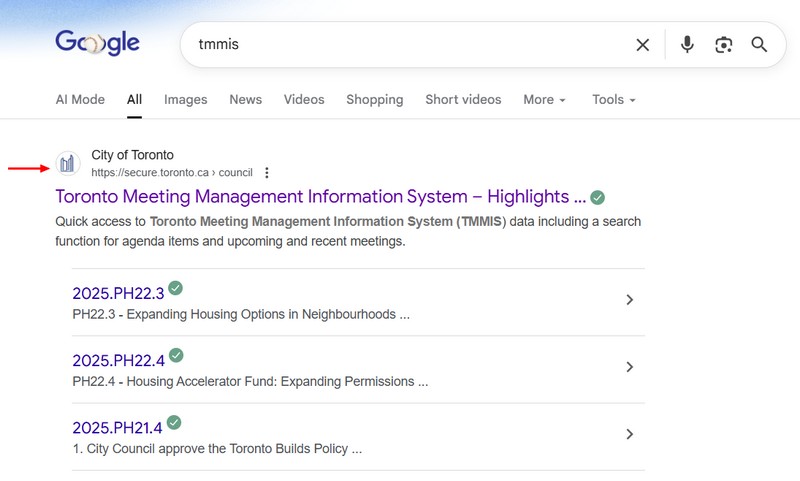
Introduction to TMMIS

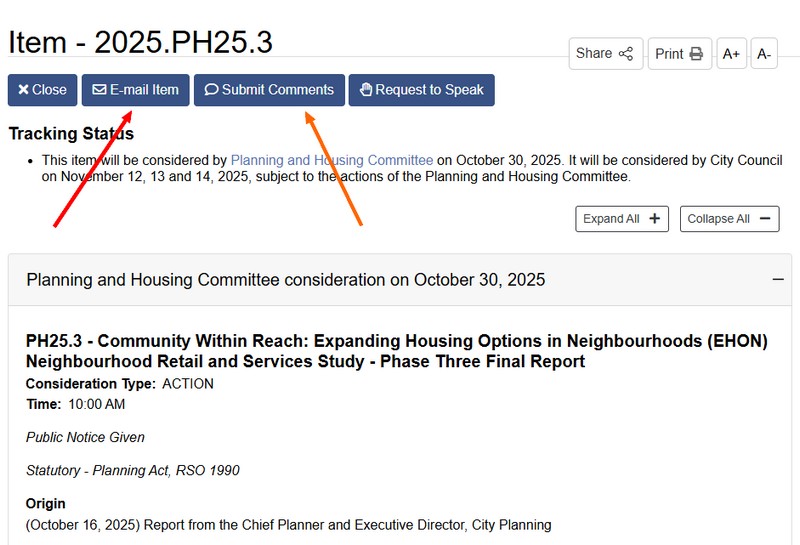
The City will accept emails that are sent through the City’s online TMMIS system. Type the keyword ‘tmmis’ into Google to find the landing page for TMMIS. Click on the landing page link.

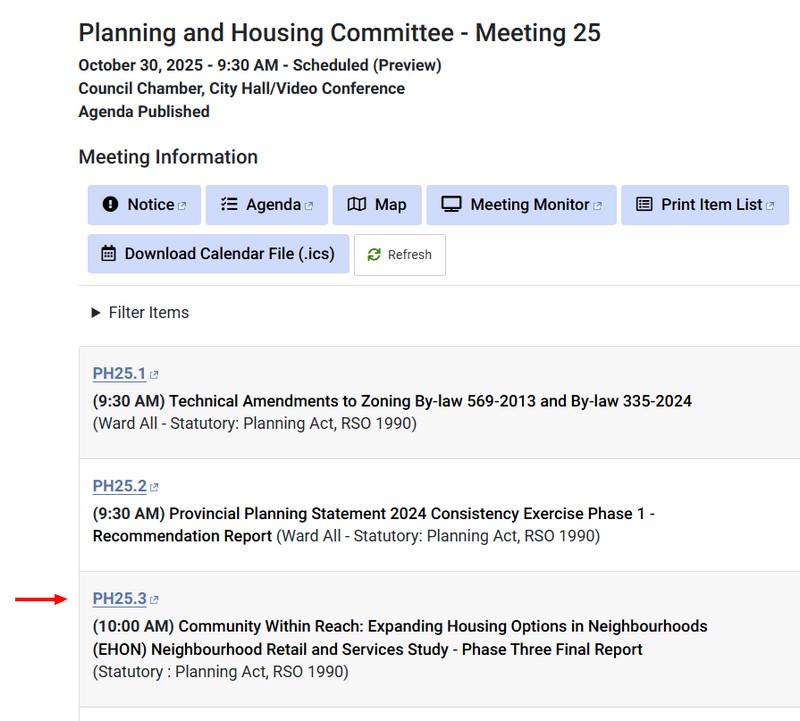
When you arrive at the TMMIS landing page, navigate to find the PHC Committee page for Meeting 25.


Find the Relevant Item in the Meeting Agenda

Scan the agenda to find the relevant item. Click on the link to navigate to the item.


Use Item Panel to Send Letters or Comments

If you want to send a letter, the letter must be in the PDF format. Select ‘Email Item’ to send a letter.

If you want to submit comments by email, select ‘Submit Comments’

If you send a letter, the full contents of the letter will be posted on the TMMIS website. These letters will be read by a large audience.

If you send comments, a notification that the comments were received will be noted on the TMMIS website. Members of the PHC committee will be able to read your comments.


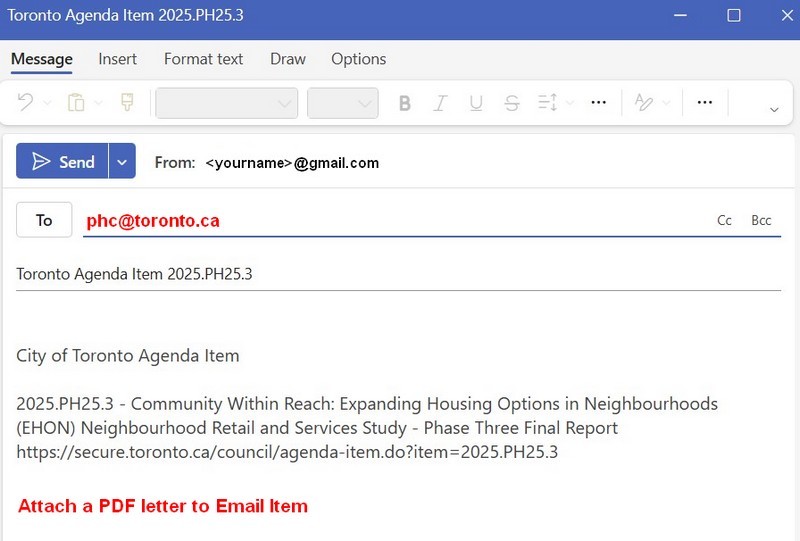
Send a Letter Item

When you select ‘Email Item’, the following screen should automatically appear on your desktop or tablet device.

You must add the recipient email address of ‘phc@toronto.ca’ to the formatted email.

You can attach your letter in PDF form and send the formatted email and attachment.

If your desktop or tablet has not been properly configured, you may need to format your email manually.

Copy the above text into your email application and add the letter attachment. Hit the send button. The TMMIS system will handle your letter in the same fashion as the formatted email.


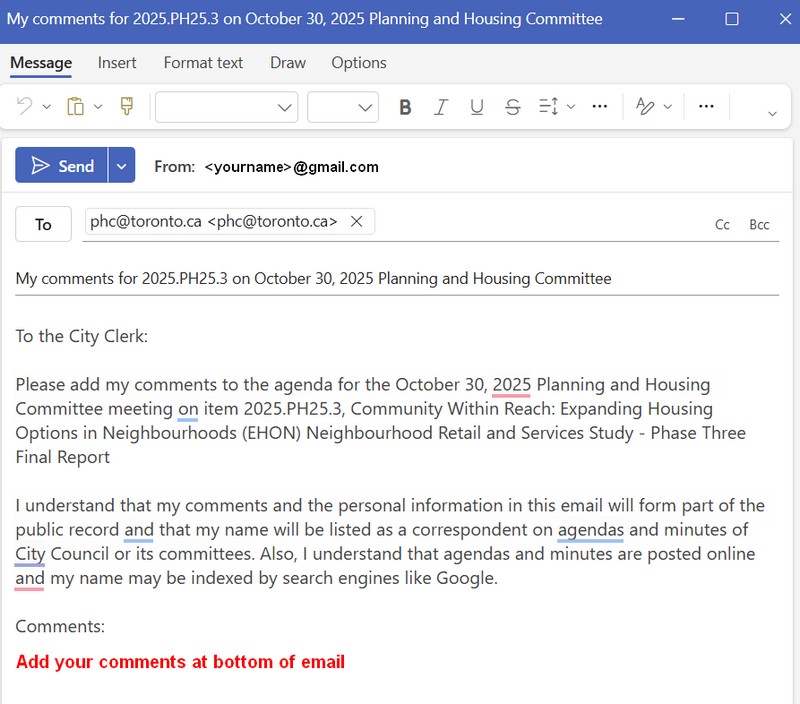
Submit Comments

When you select ‘Submit Comments, the following screen should automatically appear on your desktop or tablet device.

Note that the recipient email address of ‘phc@toronto.ca’ has automatically been added.

Add your comments to the bottom of the email and send the email with comments.

If your desktop or tablet has not been properly configured, you may need to format your email manually.

Copy the above text into your email application and add comments to the body of the email. Hit the send button. The TMMIS system will handle your email comments in the same fashion as the formatted comments email.


COTRA: Who We Are

Our Identity: Coalition of Toronto Residents’ Associations (COTRA)

COTRA is a city-wide coalition of concerned residents and residents’ associations, formed specifically in response to the City’s proposed Expanding Housing Options in Neighbourhoods (EHON) Neighbourhood Retail & Services (NRS) study.

We are united by a common desire to ensure that zoning changes that permanently alter our communities are thoughtful, appropriate, and informed by local voices.

Our Vision

We want vibrant, thriving neighbourhoods that benefit everyone. This vision is built on two core principles:

Protecting Residents’ Voices: We believe that residents deserve to be made fully aware of proposed zoning changes in detail, and that their voices should be allowed to directly inform decision-making at City Hall.

Supporting Local Business: We strongly support local businesses and believe thoughtful, targeted initiatives can allow for commercial development and a flourishing vibrant city while mitigating adverse impacts on residential neighbourhoods as outlined in the Official Plan.

Our Approach and Goals

COTRA’s work is driven by a commitment to data-driven transparency and community engagement.

Our Approach (How We Work)Our Goal (What We Aim to Achieve)
Build Awareness: Proactively inform residents about the proposed changes and their potential implications.Drive Transparency: Ensure residents have access to factual, unbiased information about the zoning proposals.
Maintain Neutrality: Deliver factual communication through our network of residents’ associations and community contacts.Achieve Meaningful Policy: Work collaboratively with City Planning, City Council, and stakeholders to advocate for appropriate and balanced policy changes.
Gather Feedback: Conduct city-wide surveys and outreach to gather resident feedback, providing objective data to policymakers.Advance Community Engagement: Increase resident participation in planning decisions that directly affect the future of their neighbourhoods.