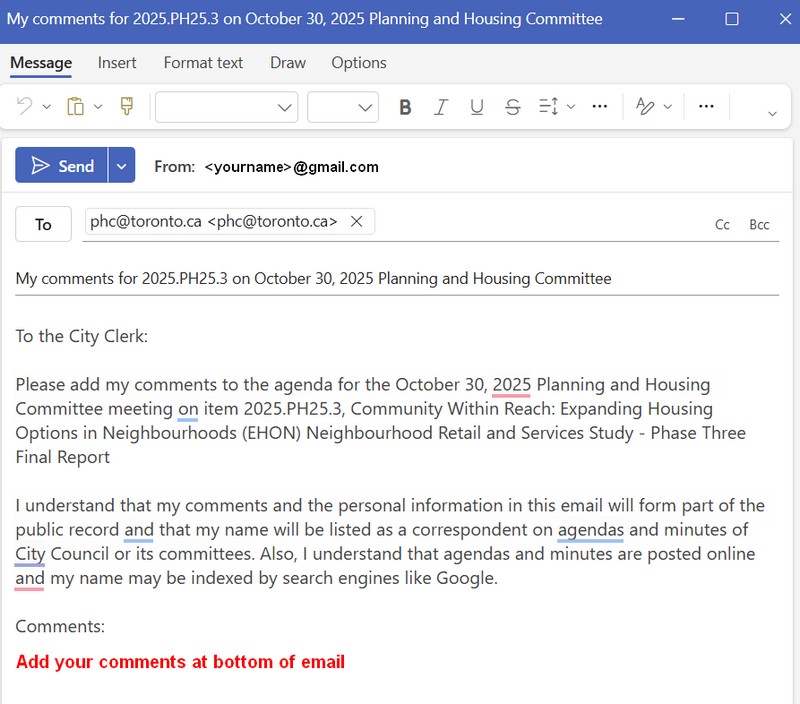
How to Send Item or Submit Comments

Introduction to TMMIS

The City will accept emails that are sent through the City’s online TMMIS system. Type the keyword ‘tmmis’ into Google to find the landing page for TMMIS. Click on the landing page link.
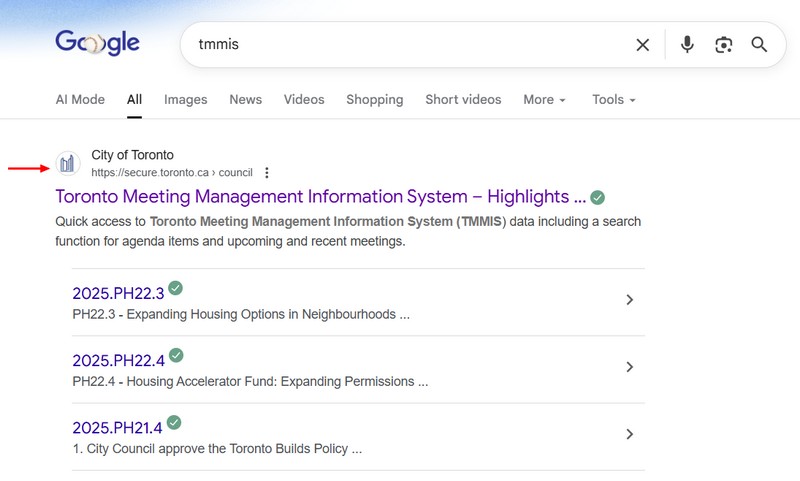
When you arrive at the TMMIS landing page, navigate to find the PHC Committee page for Meeting 25.


Find the Relevant Item in the Meeting Agenda
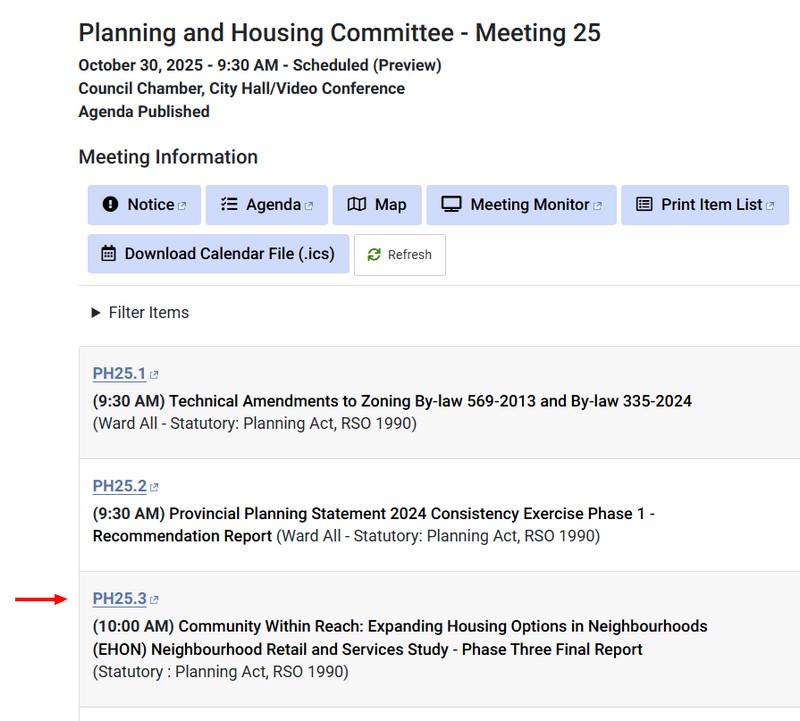
Scan the agenda to find the relevant item. Click on the link to navigate to the item.


Use Item Panel to Send Letters or Comments

If you want to send a letter, the letter must be in the PDF format. Select ‘Email Item’ to send a letter.

If you want to submit comments by email, select ‘Submit Comments’
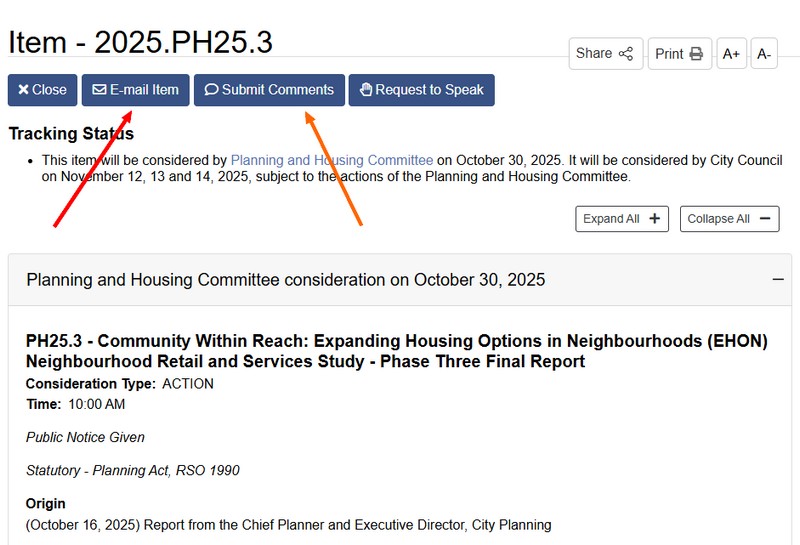
If you send a letter, the full contents of the letter will be posted on the TMMIS website. These letters will be read by a large audience.

If you send comments, a notification that the comments were received will be noted on the TMMIS website. Members of the PHC committee will be able to read your comments.


Send a Letter Item

When you select ‘Email Item’, the following screen should automatically appear on your desktop or tablet device.

You must add the recipient email address of ‘phc@toronto.ca’ to the formatted email.

You can attach your letter in PDF form and send the formatted email and attachment.
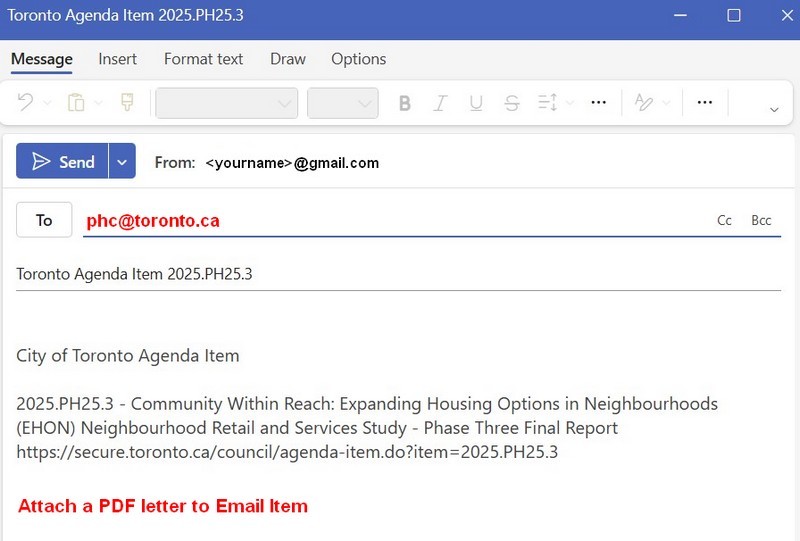
If your desktop or tablet has not been properly configured, you may need to format your email manually.

Copy the above text into your email application and add the letter attachment. Hit the send button. The TMMIS system will handle your letter in the same fashion as the formatted email.


Submit Comments

When you select ‘Submit Comments, the following screen should automatically appear on your desktop or tablet device.

Note that the recipient email address of ‘phc@toronto.ca’ has automatically been added.

Add your comments to the bottom of the email and send the email with comments.

If your desktop or tablet has not been properly configured, you may need to format your email manually.

Copy the above text into your email application and add comments to the body of the email. Hit the send button. The TMMIS system will handle your email comments in the same fashion as the formatted comments email.

COTRA: Who We Are

Our Identity: Coalition of Toronto Residents’ Associations (COTRA)

COTRA is a city-wide coalition of concerned residents and residents’ associations, formed specifically in response to the City’s proposed Expanding Housing Options in Neighbourhoods (EHON) Neighbourhood Retail & Services (NRS) study.

We are united by a common desire to ensure that zoning changes that permanently alter our communities are thoughtful, appropriate, and informed by local voices.

Our Vision

We want vibrant, thriving neighbourhoods that benefit everyone. This vision is built on two core principles:

Protecting Residents’ Voices: We believe that residents deserve to be made fully aware of proposed zoning changes in detail, and that their voices should be allowed to directly inform decision-making at City Hall.

Supporting Local Business: We strongly support local businesses and believe thoughtful, targeted initiatives can allow for commercial development and a flourishing vibrant city while mitigating adverse impacts on residential neighbourhoods as outlined in the Official Plan.

Our Approach and Goals

COTRA’s work is driven by a commitment to data-driven transparency and community engagement.

Our Approach (How We Work)Our Goal (What We Aim to Achieve)
Build Awareness: Proactively inform residents about the proposed changes and their potential implications.Drive Transparency: Ensure residents have access to factual, unbiased information about the zoning proposals.
Maintain Neutrality: Deliver factual communication through our network of residents’ associations and community contacts.Achieve Meaningful Policy: Work collaboratively with City Planning, City Council, and stakeholders to advocate for appropriate and balanced policy changes.
Gather Feedback: Conduct city-wide surveys and outreach to gather resident feedback, providing objective data to policymakers.Advance Community Engagement: Increase resident participation in planning decisions that directly affect the future of their neighbourhoods.

What Toronto residents told us – survey results

Feedback from Residents: NO to Blanket Zoning Changes

Before Toronto City Council made its decision on Neighbourhood Retail & Services, COTRA conducted a city-wide survey to understand what residents thought about the proposed changes.

The survey explained the zoning changes and obtained feedback through multiple-choice and open-ended questions.

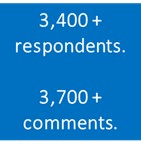
In just two weeks (September 2 – 15, 2025), over 3,400 residents from across Toronto responded, providing over 3,700 thoughtful comments.  

The message to City Planning was clear: Toronto residents overwhelmingly reject blanket rezoning for commercial uses in their neighbourhoods.

(As Presented to City Planning on October 3, 2025)


Out of more than 3,700 survey comments analyzed by COTRA, an overwhelming 96% opposed the proposal to allow businesses in residential neighbourhoods.


Key Survey Results

❌ 90%  opposed zoning changes to allow businesses in Neighbourhood Interiors.  ✓ 80% wanted the City to adopt policies to support current commercial and main street retail.  
❌ 77% opposed zoning changes to allow businesses on residential Major Streets.  ✓ 90% wanted to maintain Committee of Adjustments (CoA) process for applications to convert a residential property to commercial usage.  
❌ 96% of the 3,700 + open ended comments expressed opposition to all or some aspect of the proposal.  ✓ 57% supported community consultation to identify sections of Major Streets to rezone, where there is a neighbourhood need.  
Top concerns  – Licensed bars, patios, cannabis/vape shops, restaurants / take-out restaurants.
– Increased noise, traffic, garbage & pests, safety issues (crime, illegal businesses), and late-night operations.
– Lack of safeguards and insufficient City enforcement to protect residents
– Loss of housing and legal tenant evictions.  

Community Voices: Quotes from Survey

Quality of Life: “Why are we not protecting our neighbourhoods? These are the last peaceful areas in the city where people can have a quiet refuge. Removing our right to provide input is unacceptable.“
 
Housing Loss: “The proposal overlooks the fact that tenants on the main and second floor can be evicted legally… Why are you killing off much needed housing?”

 
Threat to Existing Commercial:  “There are numerous vacant business frontages on major city streets… The city should focus on attracting small business to these empty store frontages instead.”